


RUYAH · AMANAH AND MASLAHAH SHURA
An important decision should not be left to the judgment of the person who produced the work.How should an important decision be carried?
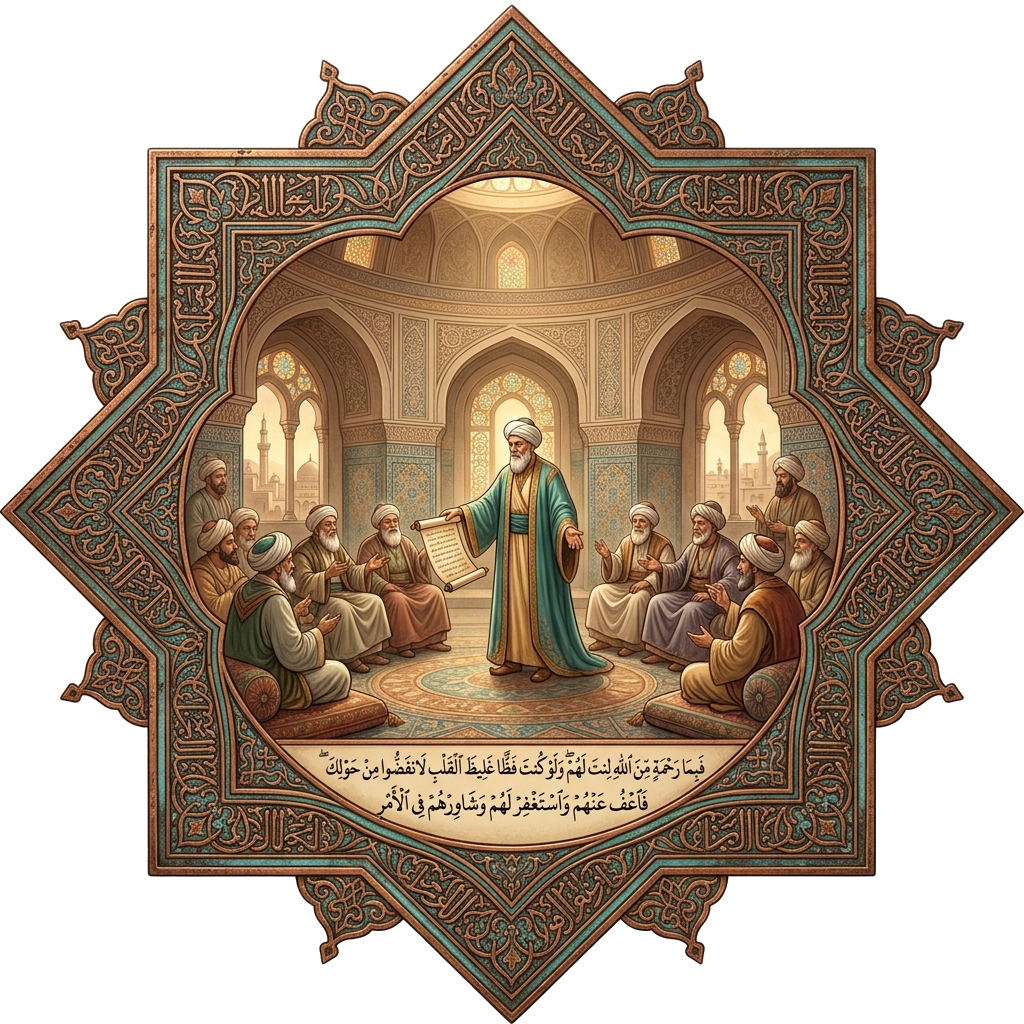
A children’s programme, religious statement, funding decision, dataset, or public release carries a different amanah. The Amanah and Maslahah Shura is the governance method we propose so that such decisions are not left to one person. It brings a matter to the relevant expertise, records the reasons, and keeps objection and correction possible. It is not a general fatwa authority speaking on behalf of SAHN-I BA.

Why is it needed?
Because good intention alone does not guarantee a sound decision or a safe outcome.
A teacher may understand a child yet not know every detail of data security. A software developer may build a model but cannot alone carry the authority of a religious statement or financial decision. An investor may provide resources but cannot alone set the limits of publication. Shura brings together those who know and those who make, the people affected and the people responsible, possibility and limit, around the same matter.
No one should be the sole judge, reviewer, and final decision-maker for their own work.
Preparation status
This page does not announce an active council, appointed members, or an open application channel.
The Shura, boards, and circles described here are a governance design under preparation. No person or body may be presented as a decision-making authority for SAHN-I BA until the required expertise, scope of duty, conflict-of-interest principles, and recording procedures have been verified. The Maslahah Shura page explains the decision principle; this family describes its proposed organisational application.
Shura, boards, and circles
Not every matter has the same weight, and not every decision belongs to the same group.
The Shura carries the shared direction and critical disagreements. Boards attend to continuing areas of expertise. Circles bring together the relevant people for a particular work, field, or period.
Amanah and Maslahah Shura
Carries the shared direction, responsibility for amanah, critical disagreements, and balance between boards.
FIQH and USUL Board
Considers religious expression, finance, waqf, family, privacy, and new questions through fiqh, usul, maslahah, and the nature of the matter.
ADAB and SEDD Board
Defines practical safeguards for children, data, models, publishing, field activity, privacy, and security.
IHSAN Review Circle
Considers quality, benefit, simplicity, representation, and usability.
Field Review Circles
Bring together qualified people in a particular field, such as BAI, Youth, NEMA, WAQF, or Valley, for as long as the matter requires.
The path of a decision
First understand the matter; then take it to the relevant expertise, correct it, and record a reasoned decision.
Not every small piece of content needs the same process. Review becomes deeper as the amanah carried and the possibility of harm increase.
01 1. Explain the matter
State clearly what is being proposed, whom it affects, and which sources and data it uses.
02 2. Identify the amanah and risks
Separate the effects on children, data, models, religious expression, finance, media, copyright, privacy, field activity, and the nature of what is involved.
03 3. Bring it to the relevant board or circle
Open the matter only to the expertise it requires; not every decision needs the whole structure.
04 4. Review and request correction
Examine sources, rights, limits, quality, representation, and usability; turn gaps into clear requests for correction.
05 5. Record a reasoned decision
Record acceptance, review after correction, limited use, postponement, or rejection together with its reasons.
06 6. Continue responsibility after release
Keep the duration of the decision, maintenance owner, error reporting, objection, renewed review, and withdrawal path visible.
Responsibilities that balance one another
Producing, guiding, offering expert judgment, protecting limits, and making a final decision are different responsibilities.
Pioneers
Open new fields and horizons.
Guides
Carry language, ADAB, and the conduct of the journey within programmes.
Advisers
Offer guidance on limits and method where specialised competence is required.
SEDD Stewards
Attend to risk, privacy, children, models, and the gate to publication.
IHSAN Reviewers
Consider quality, representation, and usability, and explain the need for acceptance or correction.
Builders
Carry production and source records; they cannot be the sole final authority over their own work.
The greater the amanah, the deeper the review.
Light
A general announcement or simple concept summary. It may be released after editorial and basic ADAB review.
Moderate
A learning module or prototype without sensitive data. It requires ADAB/SEDD and IHSAN review.
High
Children’s data, models or datasets, religious information, or finance. It is not released without the relevant board and IHSAN reviews.
Blocked
Impersonation, false information, or data used without permission. It is not released and may need to be redesigned from the ground up with a reasoned Shura decision.
On BA Internet, human responsibility does not end at publication.
No model, dataset, tool, or content carrying a high amanah should be released without review, reasons, a responsible person, and a path of correction.