

HUMAN JUDGEMENT · WILL · RESPONSIBILITY
Intelligence does not belong to the machine; it belongs to the human being who carries responsibility as khalifah.
BA Intelligence does not see the human being as someone who merely gives fast answers or processes large amounts of information. Here, khalifah is not a claim of superiority. It means understanding why we act, not surrendering our judgement, carrying the consequences and correcting our mistakes.
Understand · Discern · Decide · Take responsibility

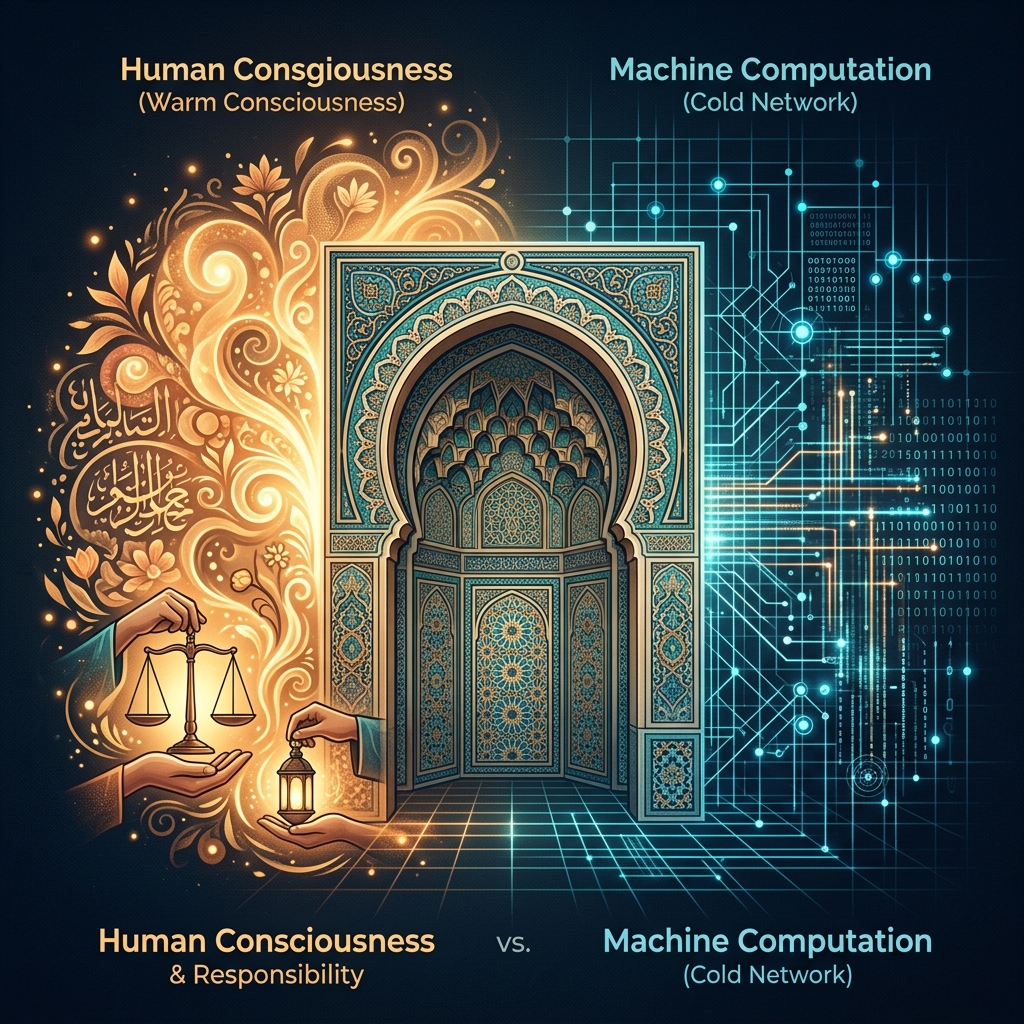
In its clearest sense
Intelligence is not only finding answers; it is framing the right question, discerning between options and answering for what you do.
A person does not decide with the mind alone, but through intention, body, experience, conscience, relationships and responsibilities. BA Intelligence keeps this whole visible. People hold a different position not because they are faster than machines, but because they can make meaning, object, give reasons for a decision and answer for its consequences.
A machine can produce an answer; a person decides where that answer belongs and how its consequences will be carried.
Where do we meet this distinction?
BA Intelligence becomes visible in daily life whenever we ask who really holds the decision.
This is not only about large technology systems. At home, at school, at work and in a production team, we face the same question: is the tool helping us, or is it quietly taking over what we think and do?
At home
When choosing a screen, resource or application for a child, you look beyond recommendation scores to age, need and the effect on family relationships.
At school
You do not confuse a student’s own work with a model output; you keep their question, language and way of thinking visible.
In a vocation
You consider a model’s suggestion alongside professional competence, field knowledge and the real situation of the person affected.
In an institution
You make clear who can change an automated result, how it can be challenged and who takes responsibility when it causes harm.
In a Builder team
You give an agent or automation only the authority it needs, and establish stopping, reversal and care from the beginning.
In your own life
You do not turn speed, scores, visibility and constant output into the measure of human worth.
Three human movements
Understand, discern and carry the consequences of your decision.
BA Intelligence does not define a person through a long list of concepts. It looks for three connected movements within an everyday decision.
Understand
See the concern, sources, purpose, people affected and what you do not know. Frame the right question before reaching for a ready answer.
Discern and Place
Distinguish evidence from claims, human testimony from model output, and benefit from harm; put knowledge and tools in their right place.
Carry the Consequences
Do not surrender the decision to a system. Explain your reasons, follow the result, and take responsibility for correction and remedy.
Khalifah and responsibility
Being khalifah is not a title of superiority; it is the responsibility to answer for the possibilities entrusted to us.
The human being is not the absolute owner of existence. Knowledge, power, time, body, nature and the ability to shape technology are trusts. Being able to do something therefore does not automatically make it necessary or right.
Trust, not ownership
We do not treat ourselves, other people, knowledge or the earth as resources available for unlimited use.
Right judgement, not speed
We do not simply seek the fastest answer; we consider rights, people, timing and consequences.
Accountability, not power
As authority grows, responsibility grows with it; consequences cannot be hidden by distributing them across providers, models or institutions.
Correction, not perfection
People can be mistaken. Maturity lies not in appearing infallible, but in admitting error, making corrections and opening a path to remedy harm.
What can a machine do, and what must a person carry?
A machine can be a powerful tool; it cannot hold intention, final judgement or accountability.
BA Intelligence does not diminish what machines can do. It keeps their useful work distinct from the responsibility that people cannot hand over.
Where machines can help
Calculate, compare and produce drafts
- Find patterns and differences across large bodies of information
- Produce alternatives, drafts and scenarios
- Speed up repetitive technical work
- Help identify sources, contradictions and missing information
- Make it easier to follow the results of an application
What must remain with people
Intend, decide and answer for the result
- Decide which concern should be addressed and why
- Consider people’s rights, voices and real circumstances
- Accept, change or reject a model suggestion
- Explain the reasons and limits of a decision
- Stop, correct and seek to remedy harm when something goes wrong
FURKAN and RÜŞD
FURKAN discerns; RÜŞD puts things in their right place.
It is not enough for a piece of information to be correct. Correct information can still cause harm when applied at the wrong time, at the wrong scale or to the wrong person.
FURKAN
Discern what something is—and what it is not
- Distinguish a source from an interpretation
- Distinguish evidence from a claim
- Distinguish truth from a human-made representation
- Distinguish human testimony from a model prediction
- Distinguish real benefit from visible success
RÜŞD
Use what is right in the right place
- Do not offer the same tool to a child, an adult and an institution in the same way
- Keep a model as a bounded assistant rather than a decision-maker
- Do not extend a small experiment to everyone before testing it
- Do not turn a temporary solution into a permanent order
- Choose a scale suited to competence, need and the ability to provide care
Knowing what you do not know
One sign of human intelligence is knowing when to stop and whom to ask for help.
Saying “I do not know” is not weakness. Instead of hiding missing knowledge behind a long model answer, a powerful title or confident language, we narrow the decision, seek other competence and move more carefully when a step cannot be reversed.
Being able to do something does not mean that we have the right or wisdom to do it.
A decision is not carried by one person alone
A sound decision brings together the voices of those who know, experience, apply and are affected by the concern.
BA Intelligence is not a story of individual heroism. A person who knows their limits works with other forms of knowledge and experience, without hiding their own responsibility behind the group.
People who know the sources
Make the guiding principles, evidence, context and differences of interpretation visible.
Professionals and field specialists
Show how the decision will work in real conditions, including its risks and practical limits.
People who are affected
Bring their lived experience, needs, objections and consequences that others may not see.
People who apply and care for the work
Explain sustainability, cost, correction and the path back when the decision does not work.
BA Intelligence for children and young people
The aim is not to turn a child into an early machine operator, but to strengthen a person who asks questions, discerns and carries age-appropriate responsibility.
Children and young people learn to use tools without surrendering their own language, curiosity, ability to object or human relationships. Through small and real responsibilities, they see consequences and ask for help when they do not know.
Ask about the source
Where did this information come from, who said it and how reliable is it?
See the model as a tool
Know that a model produces answers but does not live, intend or carry responsibility.
Think in your mother tongue
Even when using translation tools, try to explain and rebuild the concept in your own language.
Carry a small decision
Make an age-appropriate choice, give a reason, see the result and correct a mistake.
Be able to object
Ask respectful questions of a teacher, master, parent, peer or model output.
Know your limits
Stop when something is unknown, uncomfortable or risky, and turn to a trusted and competent person.
In vocations and institutions
It is not enough to say “a human makes the final decision”; people need the conditions to understand, change and take responsibility for it.
If a teacher, doctor, lawyer, manager or craftsperson lacks sufficient information, time and real authority, an approval button on a screen does not amount to human judgement.
Competence
Can the person responsible understand the concern, their profession and the limits of the tool being used?
Real authority
Can they change or reject a model result, or stop the process?
Time and attention
Do they have a real opportunity to examine, ask questions and seek alternatives?
Challenge
Can colleagues and affected people express a different view safely?
Clear reasons
Can people see which information, model and human assessment shaped the decision?
Correction and remedy
Can a wrong decision be stopped, harm addressed and the system changed?
Where can you begin?
Begin applying human judgement and responsibility in your own learning, production or vocational path.
Choose the gate closest to you. You do not need to finish every concept before learning through a real concern.
BAI Builder
Bring knowledge, games, software, data, media, design or professional experience into a production team.
Open the Builder pathTools and Machines
Explore tools not as a list of brands, but through purpose, authority, privacy, human oversight and a clear path to leave.
Explore the toolsBA Intelligence in your vocation
Explore what human judgement requires in professional work through examples and preparation records.
Enter KARDESHPaths for children and young people
Explore age-appropriate tool use, teamwork and responsible production.
See the Youth programmeFrom human judgement to digital production
Once the human responsibility is clear, explore how knowledge, data, models, software and tools are organised within BA Internet.
BA Internet is a digital field that does not reduce people to user profiles and considers sources, privacy, representation, production and contribution together.
Deeper reading
Continue in the Külliyat Library
The portal summary offers direction; the Külliyat record keeps the source, context, and path to longer reading visible.
Atlas
RUYAH Concept Atlas
A concept atlas showing the relations among ADAB, EDEB, TE'DIB, SIDRA, MA, SEDD, İHSAN, SAHN, TEMSİL, MİLLET, and WAQF.
Open the Külliyat recordBook
RUYAH, SAHN.BA and SEMANIYYA Külliyat
A preparation record for a proposed Külliyat that would bring together sources related to RUYAH concepts and the portal architecture.
Open the Külliyat recordReport
BAI Human Oversight Report
A preparation record for a proposed report on human decision, contestability, reversal, representation, and responsibility in the use of models and automation.
Open the Külliyat record